
A Designer’s AI Experiment
As a UX designer, I’m always looking for ways to streamline my workflow and push creative boundaries. So when I heard about Figma’s new AI capabilities, I had to see them in action. I wanted to know: can a tool quickly prototype a complete, narrative-driven landing page from scratch? I decided to put it to the test, and the results were more than I expected.
My goal was to create a modern, experimental landing page for a creative digital business. The prompt I gave the AI was simple yet specific:
“Design a landing page for a creative digital business with an emphasis on design experimentation, digital visuals, and technology. The focus should be on showcasing innovative and experimental work and trends in the digital design industry.”
What happened next was a fascinating look into the future of design.
The AI at Work
From a blank canvas, the AI started to work its magic. Within minutes, it wasn’t just generating a static layout; it was building a complete design system. It created components, wrote placeholder copy, and even began generating the underlying code in React. This is a crucial step for agile teams, as it gives developers a head start, saving hours of manual work.
You can see the process in this short video:
[Placeholder for .mov video]
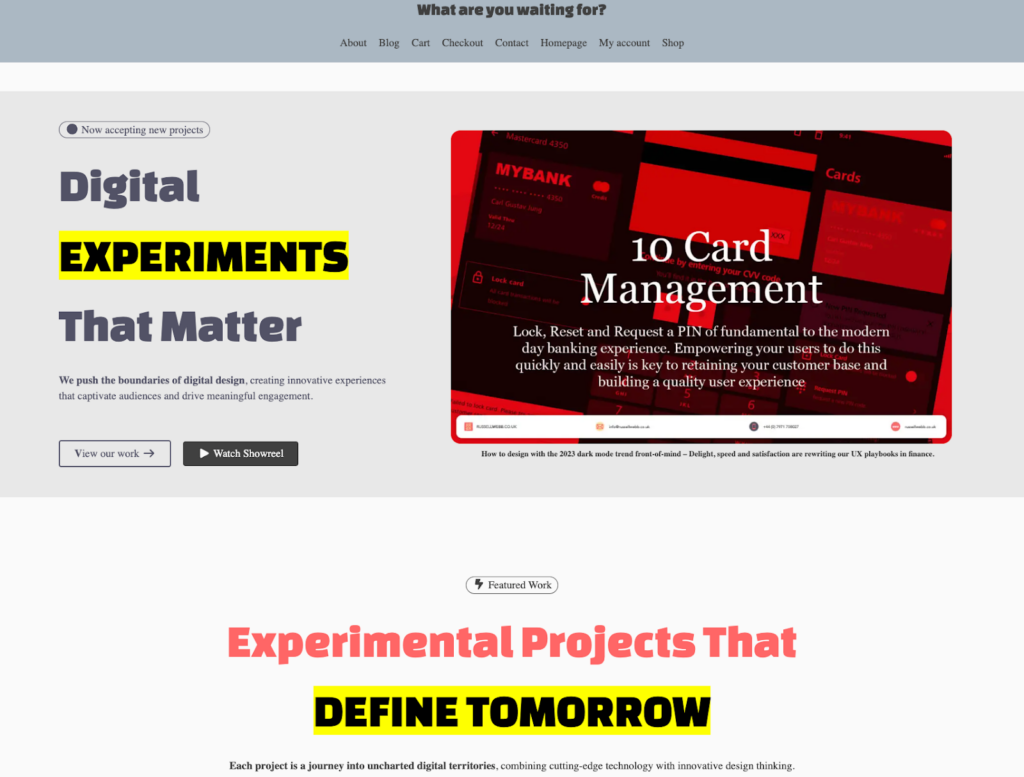
After a few minutes, the result was a fully designed, visually rich landing page. The AI interpreted my prompt and delivered a bold hero section with eye-catching gradients, a featured work gallery with interactive cards, and sections dedicated to services and industry trends.
Seeing the Design in Action
One of the most impressive parts of this process was how the AI handled responsiveness. In a world where a mobile-first approach is essential, the tool automatically created a seamless transition for different screen sizes. This is where the AI truly starts to “realise” the user experience, providing solutions for interactive elements and flawless responsiveness.
The Big Question: Validation or Innovation?
After seeing the final product, I’m left with a profound question: Did this tool just save me time, or did it save me from a necessary part of the creative process?
There’s no doubt that the AI delivered a solid foundation, tackling about 60% of the work with remarkable speed. It created a baseline of good UX patterns and clean code. However, as a designer who lives and breathes this work, I have to ask: should we feel validated that an AI can generate our base-level patterns, or does it challenge us to push web design even further to the limit?
While this technology is powerful, it comes with a few caveats:
- It’s currently an enterprise-level feature, locked behind a paywall.
- The feature must be enabled by an administrator for your entire team.
For now, these tools can save us from the mundane, repetitive tasks. But the real magic of design—the element that makes a project truly stand out—is the unique human perspective. It’s the storytelling, the subtle emotional cues, and the a-ha moments that only a human designer can bring.
Beyond the Initial Spark: Refining the AI’s Vision
While the AI’s initial output was impressive, as a UX designer, my work was far from over. The AI provided an excellent starting point, a solid conceptual framework. But a truly effective landing page goes beyond just looking good; it needs to connect with users, guide them intuitively, and convert. This is where the human element, my expertise, truly came into play.
I took the AI’s suggestions and went a step further, meticulously examining the proposed user experience. An experimental site I use as a playground: russellwebb.co.uk, became the canvas for this exploration. I adopted the AI’s structural and aesthetic suggestions, but then began to refine the UX with a critical eye. This involved:
- Deep Diving into User Flows: While the AI understood basic navigation, I delved into the intricacies of how a user would actually move through the site.
- Are the calls to action clear?
- Is the information hierarchy logical?
- I refined the navigation to be intuitive and engaging, ensuring users could effortlessly find what they needed.
- Micro-Interactions and Delight: AI can provide the framework, but often lacks the subtle touches that elevate a user experience. I introduced micro-interactions, refined button states, and considered the emotional impact of each element. It’s these small details that build trust and make a site feel polished and professional.
- Content Strategy and Messaging: The AI could populate text fields, but the nuance of compelling copywriting and strategic messaging still required human insight. I crafted the content to resonate with a target audience, ensuring clarity, conciseness, and a strong brand voice.
- Visual Enhancements with AI’s Help (Again!): Even after refining the UX, I embraced AI once more, but this time for image generation. I used another AI tool (more on that in an upcoming blog post!) to create custom, high-quality images that perfectly complemented the refined design and messaging. This demonstrated a powerful hybrid approach:
- AI for initial design,
- Human for refinement
- AI again for tailored visual assets.
Here’s a glimpse of the refined layout, showcasing the seamless blend of AI generation and human-centric design:

AI in the Design Process
- AI as a Powerful Concept-to-Iteration Accelerator: AI can undeniably provide the whole concept-to-iteration process in a rudimentary form. It’s a fantastic starting point for generating initial layouts, code, and even responsive designs, significantly speeding up the early stages of a project. However, it still requires human oversight for true refinement and strategic alignment.
- The Hybrid Future is Here: My experience demonstrated that the most effective approach is a hybrid one. AI provides the speed and initial ideation, while human designers bring the empathy, critical thinking, strategic insight, and nuanced refinement necessary to create truly exceptional user experiences.
AI vs. Human UX Designer
My three take-outs on the interplay between AI and human UX designers:
- Empathy: While AI can analyse vast amounts of user data, it struggles to genuinely understand human emotions, cultural nuances, and the subtle psychological factors that influence user behaviour. A human UX designer’s empathy is crucial for crafting experiences that truly resonate and build emotional connections.
- Strategic Vision: AI excels at pattern recognition and optimizing based on existing data. However, truly disruptive innovation and long-term strategic vision, especially in anticipating future user needs and market shifts, still largely depend on human creativity, intuition, and abstract thinking that goes beyond current datasets.
- Ethical Design: AI models can inadvertently perpetuate biases present in their training data. Human UX designers play a critical role in identifying and mitigating these biases, ensuring that AI-generated designs are inclusive, ethical, and do not inadvertently alienate or disadvantage certain user groups. The responsibility for ethical design ultimately rests with the human designer.
So, while AI can build the foundation, I believe our role is to continue pushing the boundaries, ensuring that every design tells a meaningful story and connects with its audience on a deeper level.
What do you think? Is this the future of design, or just a powerful new tool in our creative arsenal?